
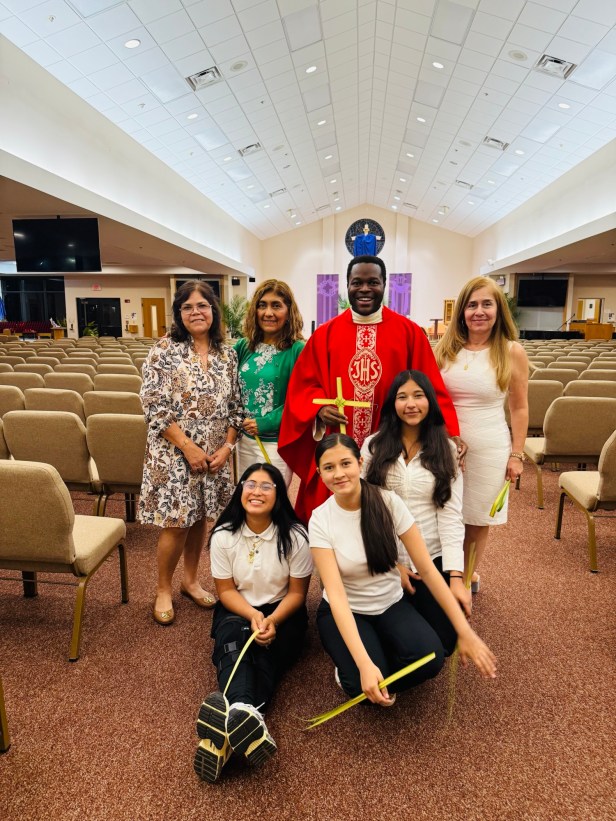
Finding Ourselves in the Passion
Is 50: 4-7; Psalm 22; Phil 2:6-11; Matt 26:14-27:66
Today we begin the Most Holy Week. Palm Sunday ushers us into one of the most dramatic moments of the Christian year. We begin with celebration—palm branches waving, voices raised in hope—yet the liturgy quickly turns toward the stark narrative of Christ’s Passion. The shift is jarring, but it is intentional. The Passion is not simply a story about people long gone; it is a story about us. Its characters are not distant figures from another age, but mirrors held up to our own hearts. As we listen to the Passion, we may be tempted to judge these characters harshly. But if we are honest, we recognize ourselves in them. Their failures, fears, and compromises are not foreign to us. They are woven into the fabric of our daily lives.
Peter’s denial was the fear of being known. Peter’s denial is one of the most painful moments in the Passion. He loved Jesus deeply, yet fear overtook him. Faced with the possibility of danger, he insisted, “I do not know the man.” We know this impulse. We deny Christ not always with words, but with silence. We do it when we witness someone being belittled and choose not to intervene because we fear becoming a target ourselves. We do it when we hide our convictions in professional settings because we worry that they might cost us influence or acceptance. We do it when we distance ourselves from someone who is suffering because their pain feels inconvenient or uncomfortable. Peter’s denial is not an ancient failure; it is the quiet moment when fear triumphs over love.
Judas’s Betrayal was the Temptation of Self‑Interest. Judas’s betrayal did not arise from hatred but from calculation. It was a small compromise, a decision that seemed advantageous, perhaps even justified. We betray ourselves in similar ways. We bend the truth to secure a promotion. We use relationships for personal gain. We choose convenience over loyalty, or comfort over integrity. Judas reminds us that betrayal often begins with something that feels small, rational, or harmless—until it is not.
The Disciples’ Flight was the Instinct to Avoid Hard Things. When danger approached, the disciples fled. They were not malicious; they were overwhelmed. Their fear was stronger than their resolve. We, too, run from what frightens us. We avoid difficult conversations because they might lead to conflict. We turn away from someone’s grief because we feel inadequate to help. We bury ourselves in distractions rather than face our own wounds or responsibilities. Their flight is our avoidance, our escape, our “not today.”
Pilate’s Cowardice was the Desire to Please the Crowd. Pilate knew Jesus was innocent. He even tried to release him. But when the crowd grew louder, he chose the path of least resistance. He washed his hands, pretending to be neutral while participating in injustice. We recognize this pattern. We go along with harmful decisions at work because speaking up feels risky. We allow gossip or prejudice to go unchallenged because we do not want to be the lone dissenting voice. We choose comfort over conscience, hoping that inaction will absolve us. Pilate’s cowardice is the temptation to protect ourselves rather than do what is right.
The Leaders’ Cynicism was the Fear of Losing Control. The religious leaders were not caricatures of evil. They were guardians of tradition, anxious about losing influence and stability. Their cynicism grew from fear—fear of change, disruption, and losing what they had built. We share this instinct. We resist new ideas because they threaten our routines. We dismiss perspectives that challenge our assumptions. We cling to being right rather than being truthful. Their cynicism is our defensiveness, our self‑protection, our reluctance to let God reshape us.
The Crowd’s Frenzy was the Power of Groupthink. The same crowd that shouted “Hosanna!” soon cried “Crucify him!” Crowds can be volatile, easily swayed by emotion, fear, or manipulation. We see this in our own world. Online mobs that shame without understanding the full story. Political or social movements that stir anger more than reflection. Peer pressure that pushes us to act before we think. The crowd’s frenzy warns us how easily we can be swept away by collective emotion rather than guided by compassion and truth.
Palm Sunday does not invite us to condemn these characters but to recognise ourselves in them. The Passion reveals our weakness, yes, but even more, it reveals God’s unwavering love for us in that weakness. Jesus does not go to the cross because we are perfect disciples. He goes because we are not. He sees our fear and still calls us. He knows our betrayals and still forgives us. He watches us run and still waits for us. He witnesses our cowardice and still believes we can be courageous. He sees our cynicism and still offers hope. He hears the crowd’s frenzy and still chooses peace.
The Passion is not ultimately a story of human failure. It is a story of divine faithfulness. Palm Sunday invites us to walk with Jesus—not because we are worthy, but because he is willing.
Today’s second reading (Phil 2) reminds us of the leitmotif of the Holy Week events. It describes how Jesus, though Son of God, “emptied himself’” of Divine Glory and “took the form of a slave”—a man like us in all things, except sin. Out of love and obedience, Jesus willingly accepted his death, “even death on a cross.” Because Jesus humbled himself and did not cling to any of his special privileges as God’s Son, “God greatly exalted him and bestowed on him the Name which is above all names.” God humbled Himself for us! All we can do in response is to bow our heads in awe, and present our loving, contrite hearts to God, begging for mercy. God wants our heart to be humbled, contrite, and truly repentant because only in that condition is it open, and so able, to receive His Mercy and His Love.
Palms branches in many parts of Africa represents a symbol of peace and reconciliation. The palm branches of Palm Sunday remind you and I, to be messengers of peace, forgiveness and reconciliation as we journey through this year’s holy week.
 VU_BIBLIA ACADEMIA