
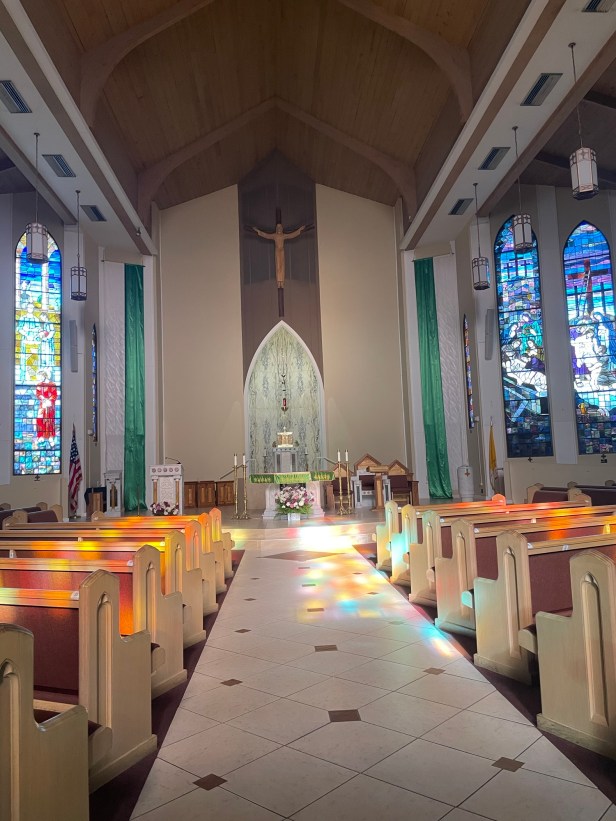
Here, I am Lord, I come to do your will – a call to holiness
Isaiah 49:3. 5-6; Psalm 39; 1Corinthians 1:1-3; John 1:29-34
The Lord said to me, “You are my servant, Israel, through whom I show my glory… I will make you a light to the nations, that my salvation may reach to the ends of the earth.”
“Now I have seen and testified that he is the Son of God.”
“You do not ask for sacrifice and offerings but an open ear.
You do not ask for holocaust and victim instead, here am I”
Your justice I have proclaimed in the great assembly
My lips I have not sealed; you know it, O Lord”
We are “called to be holy, with all those everywhere who call upon the name of our Lord Jesus Christ, their Lord and ours”
How do I fulfill my mission as a servant through whom God’s glory is shown; how do I see and testify that Jesus is Lord, the Son of God, the lamb who takes away the sins of the world? How do I proclaim God’s justice in the great assembly of men and women of our age? How do I become a light to the nations? Through a life of holiness. Yes, holiness! Saint Paul states clearly that we are all called to be holy.
So, what does holiness entail for me? How can I live a life of holiness? Does it mean I should stay in the Church day and night praying, doing mortification and retreats? Does holiness entail withdraw from the normal daily lives, from the neighborhood, from family life? Certainly Not. Holiness entails doing God’s will. Here I am, Lord, I come to do your will.
Blessed Mother Teresa of Calcutta while speaking at Harvard University said that “Being holy is not something for the few or the privileged, but the responsibility of everyone. You are called to be holy in your life as I am called to be holy in mine.” A Catholic must desire to be holy and dedicate time to the practices that nurture holiness.
Pope St. John Paul II, reminded us in the document Ecclesia in America that to imitate the holiness of God “is nothing other than to extend in history his love, especially towards the poor, the sick, and the needy (cf. Luke 10:25). To become holy is to live as Jesus lived: for others, for the Church, and for God. It is Jesus the Christ who points the way to holiness.”
Sometimes, we confuse holiness with spirituality. Spirituality is the methodology or approach or personal pastoral strategy that one uses to become holy. Think of spirituality as a path that one travels in pursuit of holiness; whereas holiness is the lived reality and byproduct of a life attuned to the Holy Spirit and spiritual living. Spirituality consists of prayer, community-life, the Sacraments, morality, religiosity, and Gospel values, and all are a means to an end—becoming holy as God is holy.
The reality is that holiness must be lived daily through a variety of activities: nurtured by prayer, reflection, and Scripture reading, holiness is lived out in works of mercy, works of charity, and in simply being Christ-like to others throughout the day. Yes, holiness is achieved in the midst of the world, in family, in community, in friendships, in work, in leisure, in citizenship.
The Lord calls us to be a light to the nations. Holiness cannot be manifested in the world unless it is manifested in us first. All Christians, from every walk of life, are called to do their part to bring holiness to our society: women and men, Catholics and non-Catholics, lawyers and judges, nurses and physicians, teachers and coaches, theologians and bishops, financial planners and economists, engineers and astronauts, steel workers and day laborers, single or married, and plumbers and priests. Whatever state of life or vocation a person is called to—married, chaste single, ordained, or religious life—the call to holiness is not an abstract “pie in the sky” mandate, but a reality that we are called to strive toward, and when we stumble and fall, we are called to get up, dust ourselves off, and continue to embark upon our lifelong pilgrimage to perfection. Everyone, every day, is called to vigorously and righteously pursue holiness.
Sometimes, we hear people say, “I am spiritual, but not religious.” In other words, they do not want anything to do with organized religion or the Church and its hierarchy, dogmas, and doctrines. But “How long can you keep up a genuine spirituality without the faith community?” Yoga and transcendental meditation may increase self-awareness of one’s interior life—which is all well and good—but the interior life must shape and reform the exterior life and move one into action, service, and outreach toward the poor, marginalized, and disenfranchised, and ultimately draw us back closer to the Divine.
Personal piety must be linked with the Church, which is holy, and follow its leader Jesus the Christ, the Divine Revelation of God’s holiness. A truly Catholic spirituality is shaped by the Catholic Church and is nourished through prayer, liturgy, the Bible, service, charity, and connecting with the other through meaningful relationships. The faith community guides us along the path of holiness.
St Paul reminds us that we are “called to be saints, called to be holy together with all those who in every place call on the name of our Lord Jesus Christ.” Holiness doesn’t mean not being involved in the world; it means working to restore and heal what is broken and sick in our world, to bring light to the dark places in our world; it means giving an authentic witnessing. It means cooperating with the lamb of God to remove the sin of the world including selfishness, discrimination, injustice and negligence. It means rising above the ego-centric tendencies to think about others and the community. Holiness is not an abstract. It is a life lived in communion with our brothers and sisters not just in our faith community but in the world as a whole.
Where exactly are you in the journey towards holiness? Have you commenced, or you are still procrastinating? Here, I am Lord, I come to do your will … guide us onto the path of true holiness.
 VU_BIBLIA ACADEMIA