
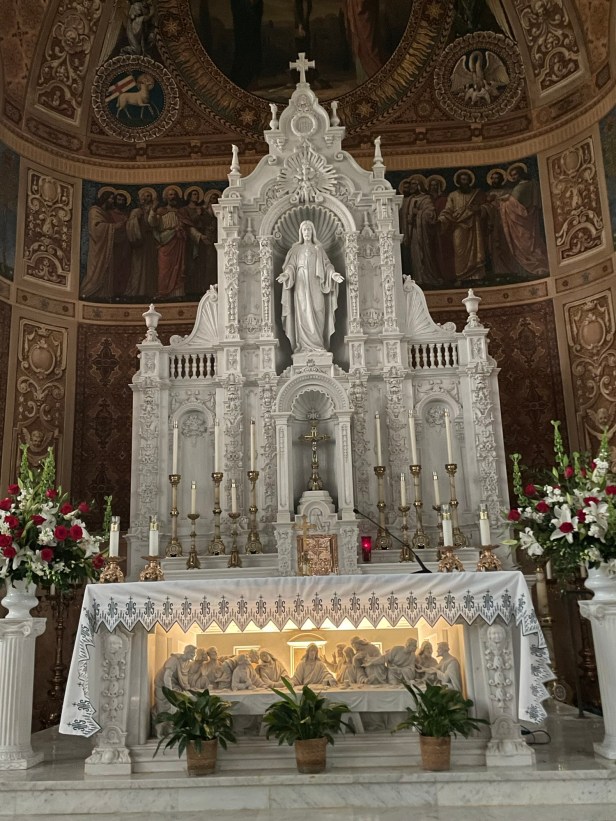
God’s Kingdom: A kingdom of justice, love and peace
2Samuel 5, 1-3; Psalm 121; Colossians 1, 12-20; Luke 22, 35-43
Today we celebrate the Solemnity of Our Lord Jesus Christ, the Universal King which brings us to the end of the Liturgical Year. We worship the King of kings and Lord of lords (Rev 17:1), and we exalt him as the sovereign Lord of the universe (Dan 7:14). Pope Pius XI instituted the Feast of Christ the King in 1925 in response to the growing secularism at the time. With this, the Church wanted to take our worship of Jesus from the privacy of our hearts to a higher level, to openly proclaim and profess his reign as Universal King. The original title of the Feast was “Iesu Christi Regis” (Our Lord Jesus Christ, the King). But in 1969, Pope Paul VI gave the feast a new title: “Iesu Christi universorum regis” (Our Lord Jesus Christ, King of the Universe).
Friends in Christ, the keywords today are King, Kingship and Kingdom. If Christ is indeed our King, what does that mean for us? Is the notion of kingship of any value to us, as democrats and republicans? Obviously, the term kingship today seems outdated, especially in democratic societies where everyone is supposed to be treated equal and free. Many rulers in past ages claimed they had sovereign authority to rule by divine edict. In the Old Testament, we read that God did not give his people Israel a king at first. Why? Because God alone was their King and they needed no other. However, God relented and chose David as King over Israel with the promise that God would raise up through David’s royal line a Savior who would establish an everlasting kingdom of righteousness and peace that would endure for all ages (Ps 89:29).
The Jews understood that the Messiah, the “Anointed One” would come as God’s anointed King to restore paradise and establish God’s reign of peace for them. They wanted a Messianic King who would free them from strife, division and from foreign oppression. Many had high hopes that Jesus would be the Messiah and Ruler for Israel. Unfortunately, they did not understand Jesus’ kind of kingship. Jesus came to deliver his people, and the whole world, from the worst kind of tyranny possible – from bondage to sin, guilt, condemnation, death (Rom 6:23) and separation from an all-merciful and just Father.
As Jesus was crucified on the cross alongside two criminals, one mocked him for his claim to divine kingship. But the other recognized through the eyes of faith that Jesus was truly God’s Anointed King and Savior. He petitioned Jesus to treat his poor soul with mercy and pardon, “Jesus, remember me when you come into your kingdom” (Lk 23:42). Jesus not only granted him forgiveness, but also a place with him in his everlasting kingdom. “Truly, I say to you, today you will be with me in Paradise.”
Jesus died not only as King of the Jews, but as King of all nations and Lord of the universe. In the Book of Revelation Jesus is called King of kings and Lord of lords (Revelation 19:16). He now sits in glory at the right hand of the Father in heaven – and from his throne he rules as Lord over all. There are ultimately only two kingdoms in this world, opposed to one another – the kingdom of light and the kingdom of darkness. The kingdom ruled by the Lord Jesus Christ – “Light of the World” characterized by truth, justice, love and peace – and the kingdom ruled by the deceiver, the “anti-Christ,” characterized by false promises, lies, and temptation to sin and disobedience.
Some Jews at the time of Christ believed that everything ends here on earth. They represent today’s materialists. This is a grave error because the kingdom of this world will pass away, but Christ’s reign is eternal. Christ, King of the Universe, is a role model for all kings, rulers, presidents, and leaders. He cares for, loves, and lives in peace with his people. He does not rule with an iron fist, military power, or financial might. He is a good shepherd, a just judge, and a compassionate king. He is the only king who treats us as his brothers and friends.
Christ, our Universal King, is divine, but he shares our humanity and allows us to share in his royal and priestly nature (Rev 1:6; 1Thess 2:12). He is always near, and there are no special protocols for reaching him. Therefore, let us celebrate because “the Lord comes to his people with justice. He will reign forever and give us a gift of peace.”
Christ lived by the truth and died for it. Christ the King joins word and action in perfect harmony. The best way to celebrate Christ the King is to work to develop his project of mercy among us. Whatever we do to help the poor, deprived and underprivileged is also a service to Christ, who identifies himself personally with people in need.
The Apostle Paul reminds us that God “has created a place for us in the kingdom of his beloved Son.” He also tells us that at the end of time, Jesus Christ will hand over the kingdom to God the Father. Today’s preface repeats this, describing the kingdom as one of truth and life, of holiness and grace, of justice, love, and peace. The kingdom of God is our hope, but it is also among us, in process. Jesus tells us how to promote the coming of God’s kingdom among us. The kingdom is near whenever justice is done to the hungry, the thirsty, the naked, the stranger and the oppressed. We are part of God’s KINGDOM when we work for peace, justice and truth in this world.
 VU_BIBLIA ACADEMIA